
Have you ever wondered how some brands seem to read your mind, offering just the right product or piece of content at the perfect moment? That’s not telepathy—it’s AI personalization at work.
AI personalization uses artificial intelligence to tailor content according to your preferences, behaviors, and interactions, transforming how businesses connect with their audience.
In this article, I’ll take you on a journey through AI personalization, revealing how it boosts the entire customer experience. From deep dives into customer behavior to real-time data analysis, I’ll explore how AI tools are revolutionizing content creation and customer relationships.
Disclosure: We earn a commission if you make a purchase at no additional cost to you. You can read our affiliate disclosure in our privacy policy.
Main Takeaways
- AI personalization enhances content relevance and boosts engagement.
- Quality customer data is the foundation of AI-driven personalization.
- Predictive analytics and real-time content adaptation are key AI techniques.
- Benefits include higher engagement, conversion rates, and customer loyalty.
- Start small with clear goals and scale AI personalization efforts over time.
- Privacy and ethical use of data are critical as AI advances.
- Keeping pace with AI tech ensures a competitive edge.
- AI personalization deepens customer connections for brands.
What Is AI Personalization in Content Marketing?

AI personalization is a sophisticated approach to creating unique experiences for each customer. But what exactly is AI personalization, and how does it function within the context of content marketing?
AI personalization is how machine learning algorithms analyze large amounts of customer data—including purchasing history, customer feedback, and engagement metrics—to deliver customized content to users.
Unlike traditional personalization, which might rely on basic information such as a customer’s name or location, AI personalization digs deeper, using data points from past customer interactions to predict future needs and preferences.
This data-driven strategy allows for hyper-relevant content delivery. From the personalized subject lines in email marketing to product recommendations, AI personalization stretches across every facet of the customer journey.
Implementing AI personalization isn’t just about the immediate wow factor—it’s about fostering an ongoing conversation that improves customer satisfaction.
By understanding and anticipating needs, AI-powered personalization helps build stronger, more meaningful customer relationships that are pivotal to long-term business success.
5 Techniques of AI Personalization in Content Marketing
Let’s explore some of the most effective AI personalization strategies.
Technique 1: Data Collection and Analysis
The basis of AI personalization is the collection and analysis of customer data. AI tools sift through numerous interactions and transactions, transforming raw data into a structured format ripe for examination.
This includes tracking user behaviors on websites, analyzing purchasing history, and incorporating customer feedback. The insights gained allow marketers to design personalized messaging that resonates with each customer.
However, with great data comes great responsibility. It’s crucial to prioritize data privacy and handle personal information ethically, ensuring compliance with regulations and maintaining customer trust.
Technique 2: Predictive Analytics

Predictive data analytics is a forward-looking technique that uses historical data to forecast future customer actions.
By applying machine learning models, AI predicts what customers might be interested in next, leading to more effective and timely personalized marketing campaigns.
Technique 3: Dynamic Content Creation and Delivery
AI excels at creating dynamic content that adapts to the context of customer interactions.
AI makes personalized content creation possible by instantaneously analyzing current data points and modifying the content accordingly, whether for a website, an app, or an email marketing campaign.
This real-time personalization keeps the content relevant and engaging for each customer.
Technique 4: Personalized Recommendations
AI-powered recommendation systems are a cornerstone of e-commerce businesses. They boost customer engagement by suggesting products or content that align with individual preferences.
Through a deep understanding of previous interactions and customer journeys, AI personalization ensures that these recommendations feel thoughtful and tailored.
Technique 5: Customer Journey Optimization
AI-driven personalization can enhance each step of the customer journey. By mapping out the entire customer experience, AI personalization tools can identify the ideal moments for engagement, delivering personalized experiences that nurture customer relationships.
By mastering these techniques, content marketers can ensure that every piece of content is seen, relevant, and compelling to the consumer. AI personalization enables a level of precision and consideration that can make each customer feel uniquely understood and valued.
Benefits of AI Personalization for Content Marketers
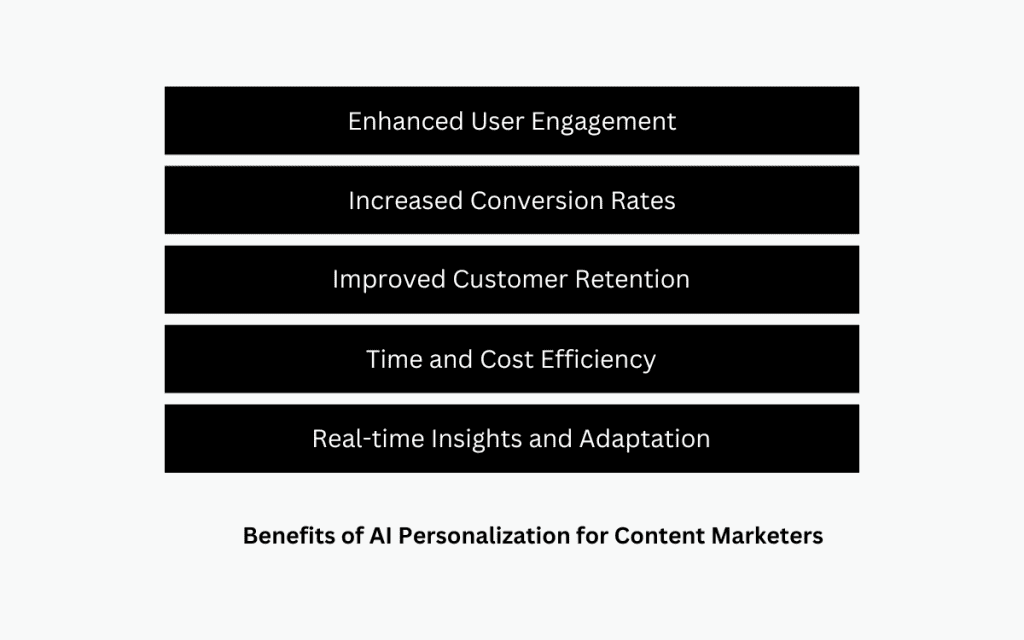
Let’s uncover the transformative benefits that AI personalization yields for content marketers.
A. Enhanced User Engagement
By tailoring content to specific interests and behaviors, AI personalization significantly boosts customer engagement.
Personalized experiences capture attention and encourage deeper interaction with the brand, whether it’s through more time spent on a website or increased activity on a mobile app.
B. Increased Conversion Rates
Content that resonates on a personal level is more likely to motivate action. AI-driven personalization fine-tunes marketing messages to align with the user’s intent and preferences, thereby increasing the chances of converting browsers into buyers.
C. Improved Customer Retention
Customers are more likely to remain loyal to brands that consistently provide value and relevancy in their interactions.
AI personalization feeds this loyalty by ensuring that each touchpoint in the customer journey feels thoughtfully curated and relevant, reinforcing positive customer relationships.
D. Time and Cost Efficiency
AI-powered tools automate data analysis and personalized content creation, reducing the time and resources required to execute effective marketing campaigns.
This efficiency allows marketers to focus on strategy and creativity, leaving the data-crunching to artificial intelligence.
E. Real-time Insights and Adaptation
The ability to adapt to changing customer needs in real-time is a game-changer for content marketers. AI personalization provides valuable insights that can be acted upon immediately, keeping campaigns agile and responsive to the dynamic nature of consumer behavior.
The benefits of implementing AI personalization in content marketing are clear: it enriches the customer experience and provides a strategic edge in a highly saturated market.
How to Implement AI Personalization in Content Marketing Strategies in 10 Steps!
Incorporating AI personalization into your content marketing strategy may seem daunting, but with the right approach, it can be an easy addition that drives significant results. Here’s how you can implement AI personalization to make your marketing campaigns more impactful:
- Assess Your Data Infrastructure: Ensure you have the systems in place to collect and manage customer data effectively. Quality data is the foundation of any AI personalization effort.
- Choose the Right AI Tools: There are a plethora of personalization tools available. Select tools that align with your marketing goals and integrate smoothly with your existing technology stack.
- Define Your Objectives: Clearly outline what you aim to achieve with AI personalization. Whether it’s increasing customer engagement, improving customer satisfaction, or boosting sales, having specific targets will guide your personalization efforts.
- Start Small and Scale: Begin your AI personalization journey with small, manageable campaigns. As you get more comfortable with the technology and start seeing results, you can expand your efforts.
- Personalize Across Multiple Channels: Apply AI personalization to various aspects of your marketing, such as personalized emails, social media interactions, and tailored website content.
- Continuously Monitor Performance: Use analytics to track the success of your personalized marketing campaigns. Look for increases in engagement, conversion rates, and overall customer satisfaction.
- Gather Customer Feedback: Customer feedback is invaluable. It can help you refine your AI personalization techniques and ensure they’re truly meeting customer needs.
- Stay Compliant with Data Privacy Laws: As you collect and use customer data, always comply with data privacy regulations to maintain customer trust.
- Iterate and Optimize: AI personalization isn’t a set-it-and-forget-it strategy. Regularly review the data and adapt your approaches to optimize performance.
- Educate Your Team: Ensure that everyone involved understands the power and purpose of AI personalization. Training your team will help them make the most of these tools.
Challenges and How to Overcome Them
Here are some key challenges and considerations to consider if you implement AI personalization in your marketing campaigns.
Potential Challenges
- Data Quality and Quantity: AI personalization requires a substantial amount of high-quality data. Insufficient or poor-quality data can lead to inaccurate personalization efforts.
- Integration with Existing Systems: Ensuring that AI personalization tools integrate seamlessly with current marketing platforms and CRM systems can be a technical hurdle for some organizations.
- Keeping Up with AI Advancements: The field of artificial intelligence is rapidly evolving. Staying ahead of new developments and understanding how they can enhance your personalization efforts is crucial.
- Balancing Personalization with Privacy: Customers value personalization, but they are also increasingly aware and protective of their privacy. Striking the right balance is essential.
Ethical and Privacy Considerations
- Transparency: Be transparent with customers about how their data is being used. Clear communication can foster trust and improve customer relationships.
- Consent: Always obtain consent before using personal data, and give customers control over their information.
- Security: Implement robust security measures to protect customer data from breaches and ensure compliance with data protection laws like GDPR and CCPA.
Best Practices for Navigating AI Personalization Challenges
- Regularly Audit Data: Conduct regular audits of your data to ensure accuracy and relevance.
- Choose Scalable Solutions: Opt for AI tools that can grow with your business and accommodate increasing volumes of data and complexity.
- Educate Your Team: Make sure your team understands the importance of ethical AI practices and data privacy.
- Stay Informed about Regulations: Keep up-to-date with changes in data privacy laws to ensure compliance.
- Prioritize Customer Experience: Always weigh personalization efforts against the overall customer experience, ensuring that personalization adds value without becoming intrusive.
Recognizing these challenges and considerations is key to successfully implementing AI personalization. When approached thoughtfully, personalization can enhance the customer experience while respecting individual privacy and preferences.
The Future of AI Personalization in Content Marketing
AI personalization is paving the way for an exciting future. As you look ahead, let’s explore potential trends and advancements in AI that will continue to enhance how marketers connect with and serve their audiences.
- Increased Use of Voice and Visual Search: As AI technology evolves, so too does the way consumers interact with content. Personalization will extend to optimizing content for voice and visual searches, allowing for more natural and intuitive customer interactions.
- More Sophisticated Chatbots and Virtual Assistants: AI advancements will enable more nuanced and complex customer conversations with chatbots, leading to personalized experiences that mirror human interaction.
- Predictive Personalization: With the continuous evolution of machine learning, AI won’t only personalize based on past behaviors but will also be able to predict future needs, delivering content and recommendations just before the user even realizes they want them.
- Augmented Reality (AR) and Personalization: AR represents a frontier for personalized experiences, allowing customers to see products in their own space and context, which can drastically enrich the buying experience and decision-making process.
- Ethical AI: As AI continues to advance, ethical considerations will become even more critical. There will be a growing focus on developing AI that is fair, transparent, and respects user privacy.
Conclusion
AI personalization offers unprecedented opportunities to engage and delight customers on a deeply individual level.
From the techniques that enable responsive content creation to the benefits, including boosted customer engagement, conversion rates, and customer retention, AI personalization is the key to crafting successful and memorable marketing campaigns.
Yet, as we implement these cutting-edge strategies, it’s essential to navigate the challenges with consideration for data privacy, ethical use of AI, and integration with existing systems.
Staying informed will help you reap the benefits of AI personalization while maintaining trust and authenticity.


