
When I first came across AnswerThePublic, the idea of visualizing keyword questions felt fresh and exciting. It was actually really helpful to me in my early days of SEO when I needed a free tool with useful insights.
Then I moved on to more advanced tools that suited my projects better.
When I stumbled across AnswerThePublic again recently, I was quite surprised to see how much it had changed under its new ownership.
You still get 3 free searches per day, but most of the results are locked behind a paywall and you can’t even download the data in a usable format (who wants to be typing out the results from a low-res png?)
If you’ve felt that same frustration with AnswerThePublic, you’re not alone – and the good news is, I’ve tested a range of alternatives that actually give you the data you need without the unnecessary limitations.
The best AnswerThePublic alternative is Answer Socrates because it gives you full keyword results, recursive search, keyword clustering, and CSV downloads – all on the free plan.
But there are some other great options that may suit you better, depending on the size of your team and the stage you’re at with your SEO strategy.
Here, I’m going to share 7 strong alternatives to AnswerThePublic – and I’m confident you’ll want to try one or two of them.
Disclosure: We earn a commission if you make a purchase at no additional cost to you. You can read our affiliate disclosure in our privacy policy.
1. Answer Socrates: Best Overall AnswerThePublic Alternative
Answer Socrates is the best alternative to AnswerThePublic because it pulls question-based keywords from the same Google sources, but it adds deeper recursive search and keyword clustering into the mix, making it much more useful overall.

You get three free searches per day with Answer Socrates (same as AnswerThePublic), but here’s the kicker: you can actually download your results as CSV files and access ALL the questions they find. No artificial limits, no paywall hiding the good stuff. Clustering credits refresh monthly, giving you 1,500 credits to organize your keyword data.
Honestly, even if you’re a long-time ATP user, Answer Socrates’ keyword clustering feature alone is worth the switch. Instead of feeling overwhelmed by a long list of keywords, you can use Answer Socrates to group related queries into logical content clusters. Use these to inform your content plan and avoid keyword cannibalization.

The report shows you CPC, competition, and search volume for each recommended cluster. You can download the CSV to see this data for each keyword too.
There are two downsides of Answer Socrates vs AnswerThePublic that I should note.
Firstly, Answer Socrates only displays search results in lists and tables. If you’re a fan of AnswerThePublic’s ‘wheel’ display (and turning your head sideways to read it), you might prefer one of the other tools on this list.
Secondly, Answer Socrates is limited to Google data, whereas AnswerThePublic lets you search Bing, YouTube, TikTok, and Instagram as well. Answer Socrates does have a couple of cool features for social media marketing (like generating questions to spark conversations on your topic – see below) but it doesn’t display search data from these platforms.

Read more about the full feature set in this review.
Pros:
- Question-based keyword research
- Recursive search reveals deeper question layers
- Keyword clustering saves hours of manual work
- Free CSV downloads
- Clean, fast interface without unnecessary visual clutter
- Affordable paid plans starting at $9/month
Cons:
- Less flashy than AnswerThePublic’s wheel visualizations
- Limited to Google data sources (no Bing or social media data)
Best For: Content creators, SEO professionals, and small businesses who need comprehensive question research and clustering on a limited budget.
Try Answer Socrates for free and see how many new ideas you uncover.
2. Ahrefs Keywords Explorer: Best Premium Alternative for All-Round SEO
If you have a healthy SEO tool budget, Keywords Explorer’s Questions report is unmatched for data depth and accuracy. I’ve been using Ahrefs for five years, and their question discovery capabilities have only gotten better over time.
Where AnswerThePublic gives you questions without much context, Ahrefs provides the full picture. Search volume, keyword difficulty, traffic potential, and SERP analysis – all in one place.

The Questions report can surface thousands of queries for a single seed keyword, complete with traffic potential estimates.
From there, it’s easy to cluster queries by parent topic or terms, and again, you can view detailed metrics for each cluster and individual keyword.

And keyword research is only one part of Ahrefs’ toolkit. You can also perform competitor analysis, compare backlink profiles, and run site audits.
The main drawback? Cost. At $129/month minimum, Ahrefs is overkill if you only need question research. But if you’re running comprehensive SEO campaigns, managing multiple clients, or need reliable search volume data, it’s worth every penny.
Pros:
- Massive keyword database with accurate search volumes
- Complete SERP analysis for each question
- Advanced filtering and export capabilities
- Part of broader Ahrefs toolset
- International database coverage
Cons:
- Premium pricing
- Overkill for simple question research needs
- Steep learning curve for beginners
Best For: SEO agencies, enterprise users, and professionals who need comprehensive keyword research with reliable data backing.
3. KeywordsPeopleUse: Best for Visual Keyword Display
If spreadsheets make you glaze over and you prefer exploring data in interactive diagrams, KeywordsPeopleUse could be the best AnswerThePublic alternative for you.

The tool organizes results by type of question and displays them in an interactive branching diagram. People Also Ask questions and keyword clustering are available as separate search options.
The search alert feature deserves a special mention. You can monitor specific keywords and get notified when new question patterns emerge. This has helped me stay ahead of trends in competitive niches, often spotting new angles weeks before they appear in other tools.
KeywordsPeopleUse does have several limitations, though.
Perhaps most importantly, it doesn’t give you search metrics – even on a top-tier plan. Once you get beyond very basic content planning, you really need to know search volume as a bare minimum.
The tool has also taken a leaf out of AnswerThePublic’s book by making you pay for CSV exports. It does have keyword clustering, but only for paid users. Plans start from $15/month.
If you can do without the fancy visuals, you’ll find that you get much better value from Answer Socrates.
Pros:
- Focuses on natural language and user intent
- Clean, visually appealing data presentation
- Keyword clustering (paid feature)
- Useful search alert functionality
Cons:
- Limited free plan (15 searches total, not daily)
- No search metrics
- No advanced filtering options
Best For: Visual learners and anyone who gets on better with diagrams than spreadsheets.
4. QuestionDB: Best for Exploring Reddit and Quora
Sometimes the best keyword research happens where people think no one’s watching. QuestionDB taps into Reddit and Quora’s massive question databases, giving you access to authentic user problems and pain points that never make it to traditional search engines.

Because Reddit questions tend to be longer than typical search queries, it’s normal for them to register zero search volume – but this doesn’t mean they’re not worth considering in your content plan. People often turn to forums because they haven’t been able to find a specific enough answer elsewhere.
What makes QuestionDB particularly valuable is the context it provides. Unlike other tools that give you isolated keywords, you can click through to see the full Reddit thread where each question originated. This helps you understand the user’s mindset, their level of expertise, and what kind of answer they’re really looking for.
QuestionDB also has a standard keyword research feature that shows basic search metrics and position history. It’s one of the cheapest SEO tools to show this kind of information.
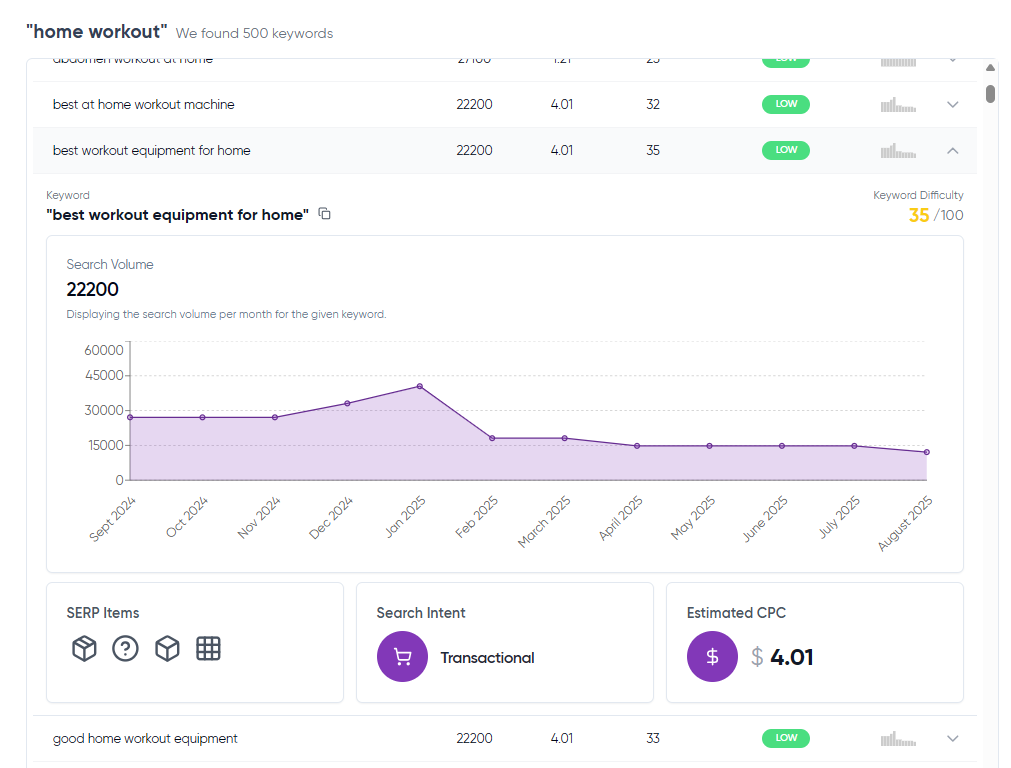
Pricing is reasonable at $9.99/month for 100 searches and full data access. The free plan only gives you 5 searches per month, which is enough for occasional use but much less generous than Answer Socrates.
Pros:
- Context from actual Reddit conversations
- Engagement metrics and history help prioritize topics
- Reasonable pricing
- Simple interface
Cons:
- No recursive search or clustering
- Limited question results compared to AnswerThePublic
- Some questions may be too specific or niche
- Free plan limited to 5 searches monthly
Best For: Community-focused businesses, B2C content creators, and anyone who needs to understand real user problems and discussions.
5. Semrush: Best All-In-One SEO and Marketing Suite
If you’re looking for a real step up from AnswerThePublic – perhaps consolidating several marketing tools into one subscription – consider Semrush.
Not only does it offer top-tier keyword research and competitor analysis; there are add-ons available for local SEO, social media, and advertising too.

The tool starts with a topic seed and generates comprehensive content ideas organized into logical subtopics. Instead of just showing you questions, like AnswerThePublic, it reveals the entire context around your topic. Headlines that are performing well, trending subtopics, and even competitor content gaps all appear in one dashboard.
Like Ahrefs, this is much more than just a keyword research tool. Semrush is built for comprehensive content strategy, so you’ll find features and data points that might be overkill for basic blog post planning. But if you’re managing content at scale, that depth becomes invaluable.
At $139.95/month for the Pro plan, it’s definitely an investment. But when you consider you’re getting keyword research, competitor analysis, content planning, and rank tracking in one platform, the value proposition becomes clearer.
Pros:
- Comprehensive keyword research and content analysis
- Headline suggestions and performance data
- Advanced topic clustering capabilities
- Competitive intelligence built-in
Cons:
- Premium option
- Can be overwhelming for simple research needs
- Steeper learning curve than standalone tools
Best For: Digital marketing agencies, large content teams, and businesses that need comprehensive SEO and content planning in one platform.
6. Soovle: Free Multi-Platform Suggestion Tool
Sometimes you need quick insights without the complexity or cost of premium tools. For this, you can try Soovle. It’s simple, completely free, and covers multiple search engines in one interface.
Soovle aggregates autocomplete suggestions from 9 platforms including Google, Bing, YouTube, Amazon, Wikipedia, and TikTok. Type in a keyword, and you instantly see what people are searching for across up to 6 of these platforms at once.

This is very helpful for getting an idea of different search intents across different platforms: commercial for Amazon and Etsy, educational from Wikipedia, and so on. You can even export the results in a single click.
The main downside of Soovle is reliability. It’s common for several platforms to be unavailable when you search.
It is completely free though, so you can’t complain too much. If you need quick top-level multi-platform comparison, it’s worth a try.
Pros:
- Completely free with no restrictions
- Multi-platform coverage (Google, YouTube, Amazon, etc.)
- Real-time autocomplete suggestions
- No registration or setup required
Cons:
- Limited to surface-level suggestions
- Poor reliability
- No search volume or difficulty data
Best For: Quick multi-platform comparisons.
7. Keywords Everywhere: Best Browser Extension for Keyword Intelligence
Keywords Everywhere takes a different approach to all these other tools by providing a browser extension that shows keyword insights as you browse.

The browser extension works across Google, YouTube, Amazon, and other platforms, showing search volume, CPC, and competition data right in the search results. Suggestions are broken down into topical, related, and longtail keywords.
You won’t discover the same volume of keywords as with Answer Socrates or AnswerThePublic, but if you’re the kind of person who’s always thinking about new content opportunities, it’s really helpful to have this keyword data available as you browse.
Keywords Everywhere has a credit-based pricing model. The minimum purchase is 100,000 credits for $60, valid for one year. If you need more, you can upgrade to a higher tier or top up your balance with PAYG credits.
Pros:
- Seamless browser integration
- Real-time data as you browse
- Works across multiple platforms
Cons:
- No separate tool
- Keyword lists are smaller than other tools
- Requires annual subscription
Best For: SEO professionals and researchers who want integrated keyword data as they browse.
Overview of the Best AnswerThePublic Alternatives
Whatever drew you to AnswerThePublic in the first place – maybe the question-based keyword discovery or the way it displays data – now you know there are other options out there. Here’s a quick rundown of the 7 tools I’ve shared here:
| Tool | Best For | Standout Feature | Pricing from |
| Answer Socrates | Solopreneurs, freelancers, small brands & agencies | Comprehensive question research and keyword clustering (available for free) | Free, then $9/month |
| Ahrefs Keywords Explorer | Enterprise SEO & agencies | Massive database with SERP analysis | $129/month |
| Keywords People Use | Visual learners | Visual keyword display | $15/month (limited free trial) |
| QuestionDB | Understanding user problems | Real Reddit conversations & context | Free, then $9.99/month |
| Semrush Topic Research | Large marketing teams | Complete topic landscape analysis | $139.95/month |
| Soovle | Occasional research | Free multi-platform suggestions | Free |
| Keywords Everywhere | Researching as you browse | Extension with seamless browser-based data | $60/year (free limited features) |
Professional Tips for Choosing a Keyword Research Tool
After 7+ years in SEO I’ve tried dozens of tools at different stages in my journey. If you’re still undecided on which keyword research tool will suit you best, ask yourself these questions:
What’s your budget? Premium tools like Ahrefs and Semrush can be tempting, but the $120+/month pricetag is significant. Don’t get seduced by enterprise features you won’t actually use – if keyword research is your main goal, Answer Socrates or KeywordsPeopleUse will do a great job.
Do you want to explore sources other than Google? Even with so many AI tools available, Google still holds a 79% share of searches. This makes it an obvious first place to look for keywords. But you shouldn’t exclude ecommerce sites or social media if they are more relevant to your business.
Are you focused on questions or broader keywords? Some tools excel at question discovery, while others include top-level keywords with higher volume and competition. If you’re just starting out with a new website or blog, low-competition question keywords can help you get traffic faster.
Do you need keyword clustering? Are you comfortable working with a large keyword list and sorting it manually, or would a tool like Answer Socrates save you a lot of time? This keyword clustering guide has more about doing it manually vs using a tool.
Your answers to these questions should help guide your decision.
FAQs
What’s the best free alternative to AnswerThePublic?
Answer Socrates offers the most generous free plan with 3 daily searches, full question access, CSV downloads, and 1,500 monthly clustering credits – all features that AnswerThePublic reserves for paid users or doesn’t have at all.
Why are CSV downloads important for keyword research?
CSV exports let you analyze, filter, and organize questions in spreadsheets or import them into content planning tools. Without this functionality, you’re stuck copying data manually – a workflow killer for serious content creation.
Do any alternatives include AnswerThePublic’s visualization features?
Most alternatives focus on actionable data over interactive visualizations. KeywordsPeopleUse is one of the best options if you prefer to view data in diagrams.
Which tool offers the most comprehensive question database?
Ahrefs Keywords Explorer provides the largest database with over 10 billion keywords, but Answer Socrates offers the best balance of database size and accessibility for most users’ needs.
Can these tools help with voice search optimization?
Yes, especially KeywordsPeopleUse and AnswerSocrates. They focus on natural language patterns and longer question formats that align with how people actually speak to voice assistants.


