
Most online stores struggle with converting visitors into customers. The average eCommerce conversion rate on Shopify is 1.4%, meaning most visitors leave without buying anything.
This doesn’t have to be your reality. Many successful online retailers have found ways to dramatically increase their conversion rates and average order values without spending more on advertising.
The best product recommendation engines offer a powerful solution to this challenge. These AI powered tools analyze customer behavior and preferences to suggest relevant products at the right time, creating a personalized shopping experience that drives sales.
When implemented correctly, they can transform your eCommerce business by helping customers find exactly what they want, even when they didn’t know they were looking for it.
Disclosure: We earn a commission if you make a purchase at no additional cost to you. You can read our affiliate disclosure in our privacy policy.
How Product Recommendation Engines Work

Product recommendation engines use algorithms to analyze data and predict which items a customer might want to buy next. They work by collecting information about your customers, including their browsing history, purchase records, and clicking patterns.
These systems typically fall into three main categories. Collaborative filtering looks at what similar customers have purchased. Content based filtering recommends products with features similar to items a customer has shown interest in. Hybrid systems combine both approaches for better results.
The magic happens when AI and machine learning enter the picture. These technologies enable the system to improve its suggestions over time as it gathers more data. The algorithms identify patterns that humans might miss and update recommendations in real time.
When a customer visits your online store, the recommendation engine quickly processes their data and displays personalized product suggestions.
The best part? This all happens automatically once the system is set up, freeing you to focus on other aspects of your business while the recommendation engine works to increase your sales.
Benefits of Using AI-Powered Recommendation Engines
Implementing product recommendation engines on your eCommerce site can transform your business results across multiple metrics that directly impact your bottom line.
Increased Sales and Average Order Value
Product recommendation engines show shoppers items that go well with what they’re already buying.
We’ve seen clients increase their average cart value after adding smart product suggestions to their checkout process. A customer buying a camera might see memory cards, cases, or tripods, which are things they actually need but might have forgotten.
These tools work because they mimic what good salespeople do naturally. They notice what you’re interested in and point out related items you might want.
Boost Conversion Rates
Getting visitors to make a purchase remains one of the biggest challenges for online stores. Product recommendation engines help solve this problem by showing customers exactly what they want.
When shoppers find products that match their needs quickly, they’re more likely to buy. These tools analyze browsing patterns and past purchases to predict what will appeal to each visitor.
The personalized experience makes shopping more seamless for your audience. Instead of scrolling through hundreds of products, they see relevant options immediately.
This targeted approach works especially well for first time visitors who might otherwise leave without buying anything. The right recommendation at the right time can turn browsers into buyers.
Enhance the Customer Experience
Online stores should feel as helpful as a knowledgeable sales associate. Good recommendation engines create an excellent customer experience by showing items people actually care about.
You’ll notice shoppers spending more time on your site when they consistently find relevant products. A customer buying running shoes will appreciate seeing appropriate socks or performance shirts that make sense with their purchase.
We can create shopping experiences that improve with each visit. The more a customer interacts with your store, the better the recommendations become.
Customers appreciate when technology makes their shopping easier too.
Reduce Bounce Rates and Increase Engagement
Visitors often leave eCommerce sites after viewing just one page. Product recommendation engines help fix this problem by giving them reasons to explore further.
You can capture interest quickly by showing visitors products that match what they’re looking at.
We’ve found that personalized recommendations encourage shoppers to click on more products and spend additional time browsing. You’ll notice recommendation engines work especially well for new visitors who might otherwise leave without seeing what your store truly offers.
Key Features to Look For in a Recommendation Engine
Machine Learning Capabilities
You want a recommendation engine that gets smarter over time. Look for systems that learn from customer interactions and improve automatically.
We recommend choosing engines that can identify complex patterns in shopping behavior. The best tools adapt to seasonal trends and changing customer preferences without requiring constant manual adjustments from your team.
Real-Time Personalization
We need recommendation engines that respond instantly to customer actions. When a shopper adds an item to their cart, the suggestions should update immediately.
You’ll want a system that considers current browsing behavior, not just past purchases. This real-time approach ensures customers see relevant products based on what they’re interested in right now.
Multi-Channel Support
Your customers shop across multiple devices and platforms. We need recommendation engines that work seamlessly everywhere.
You should look for systems that maintain consistent recommendations between your website, mobile app, email marketing, and social media shops. This unified approach creates a cohesive shopping experience regardless of how customers interact with your brand.
Detailed Analytics and Reporting
You need good data analytics to know if your recommendation engine is actually making you money. The best systems show you exactly how many clicks turn into sales.
We love seeing which product pairings perform best with different customer groups. This insight helps you tweak your approach and proves whether your investment is paying off. Good reporting makes it clear when something’s working well or needs adjustment.
Easy Integration with Existing Platforms
Nobody wants to rebuild their entire website just to add recommendations. You need a system that plays nicely with your current eCommerce platform.
We’ve found the best recommendation engines offer simple plugins for popular platforms like Shopify and WooCommerce. Look for tools with good APIs that connect smoothly with your existing tech stack without causing headaches.
Top Product Recommendation Engines for eCommerce in 2025
1. Adobe Target

Adobe Target stands out as a heavyweight in the product recommendation space, especially for mid-size to enterprise eCommerce businesses. Part of the broader Adobe Experience Cloud, it offers more than just basic recommendations.
What we like most about Adobe Target is its exceptional AI capabilities. The system uses Adobe Sensei, their artificial intelligence and machine learning framework, to deliver highly personalized product suggestions based on both historical and real-time data.
You can create sophisticated recommendation rules without needing a technical background. The visual interface makes it easy to set up different recommendation strategies for various pages and customer segments.
We’ve seen clients achieve impressive results with their A/B testing features. You can test different recommendation approaches against each other to see which drives more sales.
The multi-channel capabilities really shine too. Adobe Target maintains consistent recommendations across web, mobile, apps, and even in-store kiosks.
Integration is straightforward with most major eCommerce platforms, though you’ll get the most benefit if you’re already using other Adobe products. Their customer support team provides solid guidance during implementation.
2. Dynamic Yield

Dynamic Yield delivers personalization that adapts to each customer in real time. Recently acquired by Mastercard, this platform has continued to evolve with even stronger capabilities.
What makes Dynamic Yield special is how it unifies personalization across your entire customer journey. You can create consistent experiences from your homepage to product pages, cart, and even email campaigns.
We appreciate their approach to segmentation. The platform automatically identifies different customer groups based on behavior patterns, allowing you to tailor recommendations for first-time visitors, loyal customers, and everyone in between.
Their predictive targeting stands out from competitors. The system anticipates what products a customer might want next based on subtle browsing signals, not just obvious clicks.
You’ll find their visual editor particularly helpful for setting up recommendation widgets without needing developer help. Drag-and-drop functionality makes it easy to place recommendations exactly where you want them.
Dynamic Yield works well for both small businesses and large enterprises. The platform scales smoothly as your traffic grows, maintaining fast performance even during high-volume sales events like Black Friday.
3. Nosto
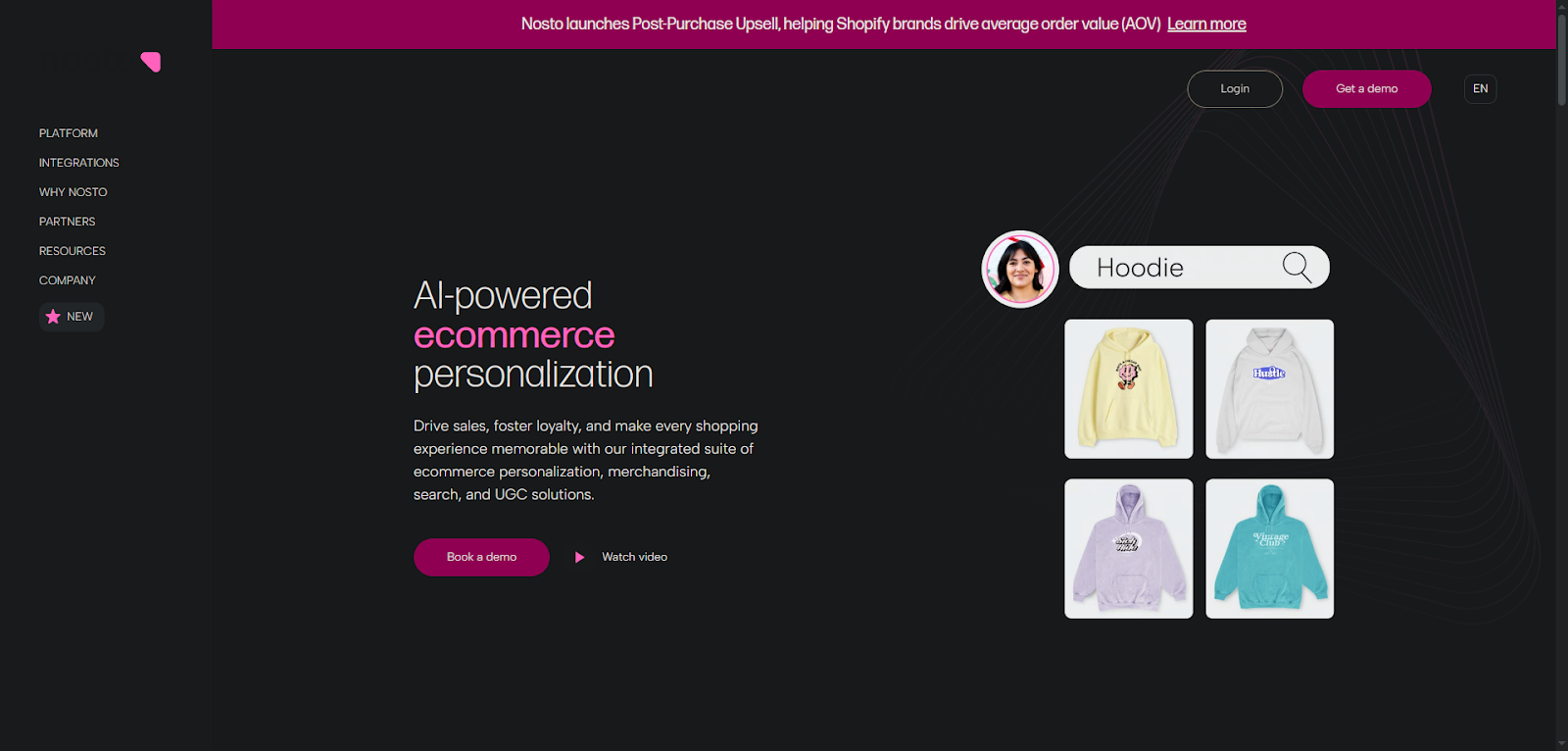
Nosto has built a strong reputation as a recommendation engine specifically designed for eCommerce. Their laser focus on online retail shows in how well they understand the shopping experience.
What we like about Nosto is their quick implementation process. You can have personalized recommendations running on your site within days, not weeks. Their JavaScript tag installation is straightforward for most eCommerce platforms.
The visual merchandising tools give you control over how recommendations appear. You can create attractive product displays that match your brand while still leveraging AI for the selection process.
Nosto excels with their segmentation capabilities. The system automatically groups customers based on shopping behavior, allowing you to show different recommendations to browsers versus buyers.
We’ve seen great results with their behavioral triggers. When a customer shows signs of leaving your site, Nosto can display targeted recommendations to recapture their attention.
Their mobile optimization deserves mention too. The recommendations adapt beautifully to smaller screens, maintaining a good user experience regardless of device.
Nosto works particularly well for fashion, beauty, and home goods retailers where visual presentation matters.
4. Bloomreach

Bloomreach combines search and product recommendations into a powerful discovery platform. Their approach focuses on helping customers find exactly what they want, even when they’re not sure what they’re looking for.
We’re impressed by their visual recommendation capabilities. Shoppers can click on different elements within product images to find visually similar items – perfect for fashion and home décor retailers.
Their AI engine stands out for understanding customer intent. Bloomreach analyzes search queries, clicks, and browsing patterns to predict what products will resonate with each visitor.
You’ll appreciate how their system handles seasonal trends automatically. The platform identifies and promotes trending products without requiring manual intervention from your team.
We like their “Frequently Bought Together” algorithms that update automatically based on actual purchase data. These create natural cross-selling opportunities throughout the shopping experience.
Bloomreach works particularly well for retailers with large product catalogs. Their search-powered recommendations help customers navigate extensive collections without feeling overwhelmed.
The platform integrates smoothly with major eCommerce systems and provides clear analytics to track performance.
5. LimeSpot

LimeSpot works well for small to medium-sized eCommerce businesses. It makes advanced AI accessible without enterprise-level complexity.
Their segment-specific approach automatically groups customers based on behavior and adjusts recommendations accordingly. When shoppers interact with products, suggestions update immediately across your site.
LimeSpot’s upsell and cross-sell features identify natural product pairings that increase average order values. Their dashboard clearly shows how recommendations affect conversion rates and revenue.
It integrates especially well with Shopify stores. Setup typically takes less than a day, with minimal technical requirements.
LimeSpot handles seasonal trends effectively, automatically adjusting recommendations based on changing shopping patterns. The AI engine improves over time as it collects more data about your specific customers.
The system works across desktop and mobile interfaces with consistent performance.
The Bottom Line
Product recommendation engines transform eCommerce stores from basic catalogs into personalized shopping experiences that drive more sales. The right system can significantly boost your conversion rates and average order values.
The technology has matured to the point where businesses of all sizes can now implement sophisticated recommendation strategies without massive technical investments. The key is choosing a solution that matches your specific needs and customer base.
Check out other Triple A Review articles for more ways to grow your online store. We’ve covered plenty of topics that complement these recommendation engines perfectly.


